
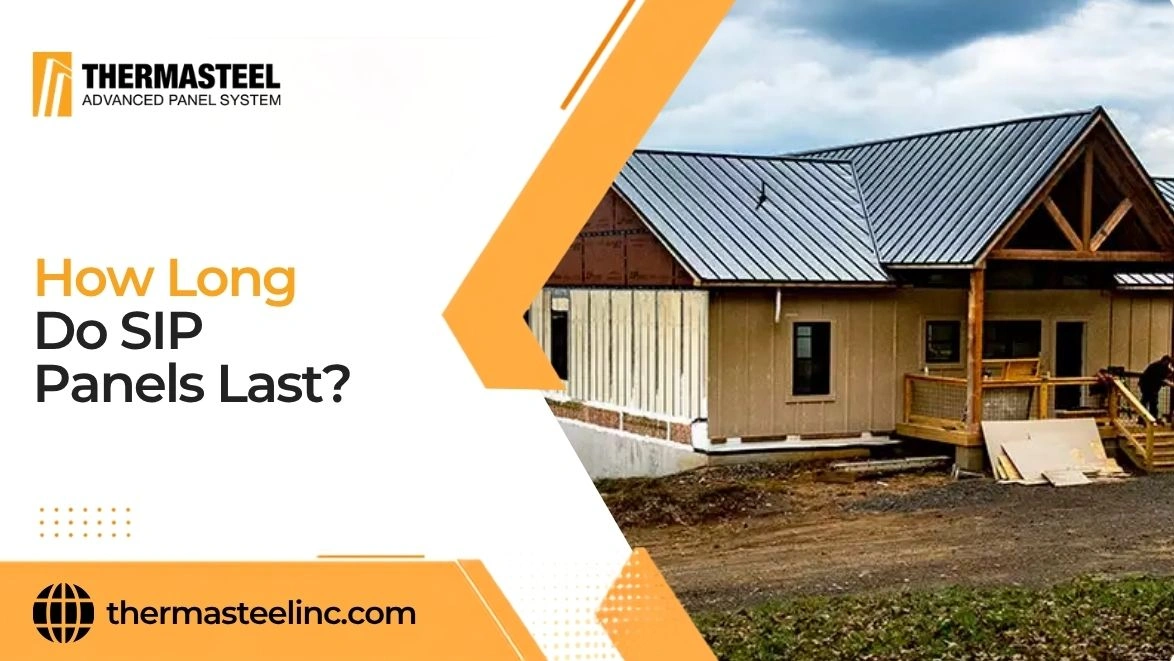
Metal structural insulated panels (SIPs) combine a metal structure, most often galvanized light gauge steel, with a rigid foam core such as expanded polystyrene (EPS). Because neither material is organic, these panels avoid the rot and decay that limit wood assemblies. Their actual service life still depends on the specific panel system, site conditions, installation quality, and routine building maintenance.
Key Takeaways
- Manufacturers of metal SIPs with EPS cores estimate a life expectancy of up to 425 years. This is a projected service life, not a warranty term. Panel material warranties are typically much shorter, often around 10 years.
- Metal framing and a rigid foam core are not food sources for rot, mold, or insects, which removes the main causes of decay in wood framing.
- The factory-bonded composite design keeps the panel dimensionally stable and limits air leakage over time.
- Correct installation, including sealed joints and a protected base connection, has a large effect on how long the building envelope performs.
How Metal SIP Components Hold Up Over Time
A metal SIP’s lifespan comes down to its two main components: the metal structure and the foam core.
Metal framing
Steel is the most common metal used in SIPs, typically as galvanized light gauge studs that carry the structural loads. Some metal panel systems instead use thin steel or aluminum facings bonded to the foam. Unlike wood, metal does not shrink, twist, or bow as moisture levels change, and it cannot split along a grain. In some metal SIP designs, the studs are bonded to the faces of the foam and turned sideways. This creates a thermal break and orients the stud’s stronger side in the shear direction. Galvanizing protects the steel from corrosion, provided the assembly is kept reasonably dry.
Foam core
Most metal SIPs with bonded steel framing use an expanded polystyrene (EPS) core. The EPS core is a solid block of foam, not a cavity filled with loose or batt insulation. Fiberglass batts can slump over time and leave gaps at the top of a wall. Rigid EPS stays in place and keeps its shape. EPS also contains no blowing agent that escapes over time, so its R-value stays stable over the life of the panel. Some metal panels use polyisocyanurate (polyiso) or polyurethane cores instead. These start with a higher R-value per inch but can lose some of it over time as blowing agents diffuse out. Manufacturers of steel-framed EPS panels report effective thermal performance of R51 to R61 for 5.5- to 7.5-inch exterior walls, depending on thickness and foam density.
How wall systems compare
| Wall Construction Type | Key Durability Considerations |
|---|---|
| Standard wood stud framing | Vulnerable to moisture, rot, termites, and dimensional change over time. |
| OSB-faced wood SIPs | Organic wood facings need ongoing protection from prolonged moisture. |
| Metal SIPs (steel framing, EPS core) | Resistant to rot and mold. Total lifespan depends on assembly quality and installation. |
In practice, these material properties show up in three ways:
- Dimensional stability. Metal framing does not shrink or twist, so walls stay plumb and square.
- Stable insulation. Rigid foam does not settle or slump, so thermal performance stays consistent.
- Biological resistance. Metal and foam are not food sources for fungi or wood-eating insects, so they resist mold and rot.
Factors That Affect Durability
Metal and foam do not rot, but building design and installation still determine how long the envelope performs.
Joint sealing and exterior cladding
In bonded metal SIP systems, the panel acts as framing, insulation, sheathing, and vapor barrier in one, so a separate vapor barrier is generally not required. Panel joints, however, must be sealed as specified. Water entering through unsealed joints won’t rot the panel, but it can damage drywall, flooring, and finishes. Follow the manufacturer’s installation guide and local code for any weather-resistive barrier, flashing, and cladding details.
Moisture exposure
Closed-cell foam cores such as EPS absorb little moisture, and galvanized steel and aluminum resist corrosion. Neither material is completely immune to prolonged water exposure. Good drainage, flashing, and a protected base connection keep the assembly dry and fasteners free of corrosion. This matters most in below-grade applications.
Foundation and base connection
A wall system relies on a stable foundation. Installing the bottom track over a sill sealer or gasket helps block moisture from wicking up out of the concrete slab. Keeping that connection dry protects the track and its fasteners over time.
UV exposure during construction
Raw EPS should not sit in direct sunlight for long periods. Extended UV exposure can yellow and degrade the foam surface. Installing cladding within normal construction timelines protects the foam.
Pests
Metal and foam provide no nutritional value to termites or carpenter ants, so they are not damaged the way wood framing is. Termites can still tunnel through foam insulation to reach wood elsewhere in a building. In areas with heavy termite activity, building codes may restrict foam below grade or require additional termite protection. Check local requirements before specifying below-grade panels.
Fire, wind, and seismic loads
Metal framing is non-combustible, and panel assemblies can be tested for fire resistance and low smoke and flame spread. Lightweight metal panels also perform well under wind and seismic loads when engineered for the project. Some hurricane-rated metal SIPs are tested to withstand 185 mph winds, including flying debris. Actual performance depends on the specific panel, its engineering, and its connections.
Installation Practices That Support Long Service Life
Metal SIPs typically arrive pre-cut, labeled, and diagrammed, so assembly follows the project’s shop drawings. Exact steps vary by system, so always follow the manufacturer’s installation manual. A typical wall sequence looks like this:
- Set the base track. Anchor the galvanized bottom track to the foundation over a sill sealer to separate it from slab moisture.
- Place the first panel. Set a corner panel plumb and level to establish a square reference for the wall run.
- Seal the joints. Apply the specified sealant along panel edges before connecting each adjacent panel.
- Fasten the connections. Secure panels to each other and to the tracks with the specified fasteners, tying the units into one assembly.
- Cap the wall. Install the top track to lock the wall run together before setting roof or floor framing.
Conclusion
Metal SIPs with rigid foam cores remove the main causes of decay in wood construction: rot, mold, insect damage, and insulation that settles over time. Manufacturers project service lives measured in centuries, but real-world lifespan still depends on engineering, installation, moisture management, and maintenance. Choosing a properly specified panel and installing it correctly does the most to protect long-term performance.
Frequently Asked Questions
Do metal SIPs lose insulation performance over time?
Not with an EPS core. Solid EPS does not settle or slump, and it has no blowing agent that escapes over time, so its R-value stays stable. Polyiso and polyurethane cores can lose some R-value over time as blowing agents diffuse out.
Can moisture damage a metal SIP?
Metal and closed-cell foam do not support rot or mold, and they absorb little moisture. Prolonged water exposure can still corrode fasteners and damage interior finishes. Sealed joints, proper flashing, and a dry base connection prevent this.
Do metal SIPs need a separate vapor barrier?
Usually not. Bonded metal SIPs are typically designed to serve as framing, insulation, sheathing, and vapor barrier. Follow the manufacturer’s guide and local code for any weather-resistive barrier behind cladding.
How long is the warranty compared to the expected lifespan?
They measure different things. A projected life expectancy of up to 425 years is an estimate of how long the materials can last. A material warranty, often around 10 years, is the manufacturer’s formal guarantee.
How do metal SIPs handle severe weather?
When engineered for the project, metal SIPs can be designed for local wind, snow, and seismic loads. Hurricane-rated panels are available for high-wind regions.
You must be logged in to post a comment.