
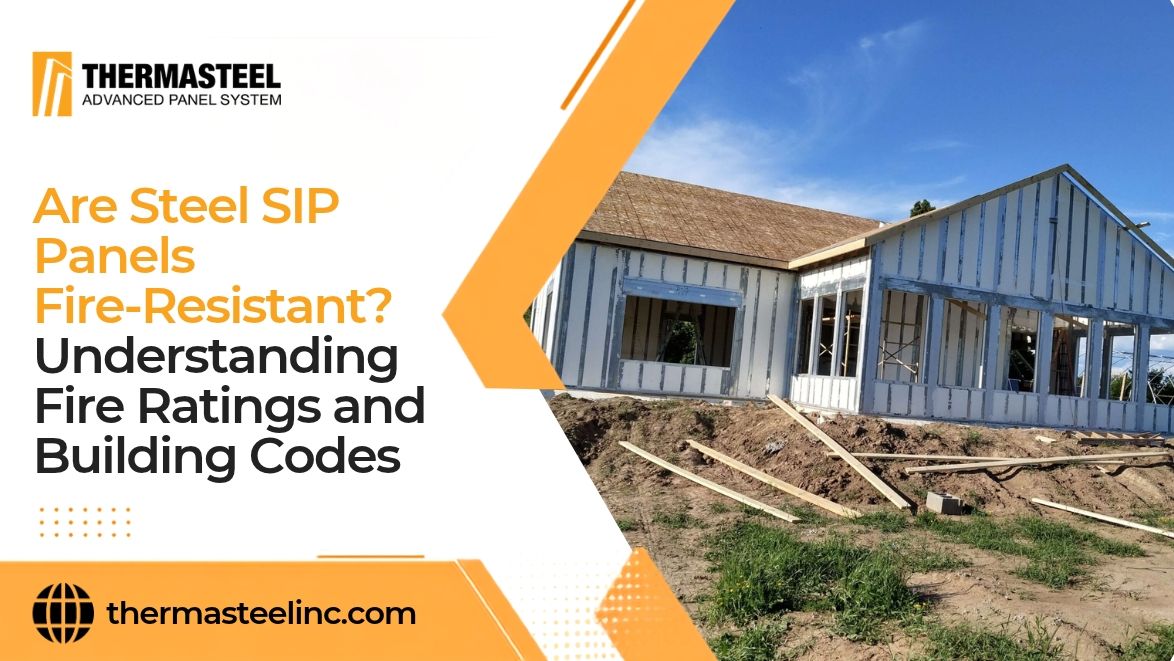
Fire safety questions can stall a steel structural insulated panel (SIP) project quickly, especially when a plans examiner asks for test data nobody has gathered. The short answer is yes. Tested steel SIP assemblies can reach fire ratings of one hour or more once they’re covered with gypsum board and built as tested. The steel frame won’t burn. The foam core still needs protection, which is where building codes step in. Knowing those rules makes steel SIP panel fire resistance far easier to plan for.
Key Takeaways
- Steel SIP panels can be fire-resistant. Steel framing doesn’t burn, while the expanded polystyrene (EPS) core is usually flame-retardant treated and protected by gypsum board.
- Hourly fire-resistance ratings come from full-scale tests of the complete wall or floor assembly. Flame-spread and smoke-developed ratings measure how the foam itself burns and smokes.
- Fire performance depends on steel gauge, foam treatment, gypsum layers, joint sealing and installation quality, not on the panel alone.
- Building codes require foam plastic to meet surface-burning limits and sit behind a thermal barrier. Steel SIPs usually gain approval through evaluation reports and tested assemblies.
Can Steel SIP Panels Withstand Fire?
Steel SIP panels hold up well in fire when they’re part of a finished assembly. Light-gauge steel doesn’t ignite or feed flames, unlike the wood studs and oriented strand board (OSB) facings found in many conventional panels.
Steel still has limits. According to the American Institute of Steel Construction, steel keeps nearly all its strength up to about 600°F but retains only about half at roughly 1,100°F. The EPS core is combustible as well. Treated foam resists ignition but softens and shrinks under high heat. That’s why codes count the gypsum covering as part of the protection.
Understanding Fire Ratings for Steel SIP Panels
Two different kinds of ratings appear on fire test reports. One measures how long a whole assembly survives a fire. The other measures how quickly flames and smoke spread across a material’s surface. Both matter for code approval.
Fire-Resistance Ratings and Hourly Testing
Hourly ratings come from ASTM E119, a full-scale furnace test published by ASTM International. Labs build a full wall or floor, usually under load, then heat one side along a standard fire curve. The test ends when any of these happen:
- Structural failure: a load-bearing wall can no longer carry its load.
- Flame passage: flames or hot gases reach the unexposed side.
- Heat transfer: the unexposed face passes set temperature limits.
The result is a rating such as one or two hours. That rating applies only to the exact assembly tested, including its gypsum layers, fasteners and panel thickness. Some steel SIP systems publish two-hour load-bearing results.
Flame-Spread and Smoke-Developed Ratings
ASTM E84, known as the tunnel test, measures how fast flame travels along a material’s surface and how much smoke it releases. Results come as two numbers, a flame spread index and a smoke-developed index. Flame spread results fall into three classes:
- Class A: 0 to 25
- Class B: 26 to 75
- Class C: 76 to 200
Foam plastic insulation used in buildings must typically score 75 or less for flame spread and 450 or less for smoke at its maximum intended thickness. These numbers describe surface behavior only, not how long a wall holds up.
What Factors Affect the Fire Performance of Steel SIP Panels?
A fire rating belongs to a complete system rather than to any single material. Three groups of details decide whether a steel SIP wall performs on site the way its test report says it should.
Steel Framing and EPS Foam Insulation
Thicker steel holds its strength longer as temperatures climb. Gauge therefore matters most on load-bearing walls. Building-grade EPS usually contains flame retardants that slow ignition. Density and core thickness also shape how a panel behaves once heat reaches the foam.
Gypsum Board and Other Protective Barriers
Gypsum board does much of the fire-protection work in a steel SIP wall. Codes require foam plastic to sit behind a thermal barrier, most often half-inch gypsum wallboard, which slows heat from reaching the foam. Common ways to add protection include:
- Type X gypsum, which contains glass fibers for longer fire resistance
- Extra gypsum layers on the fire-exposed side
- Stucco, masonry or cement board outside, if the tested assembly allows it
Panel Joints, Connections, and Installation Quality
Gaps let heat and flames bypass protection. Panel joints, top and bottom tracks and openings for wiring or plumbing all need proper sealing. Installers must fasten gypsum at the spacing listed in the tested design. Changing screw spacing, board type or layer count can void the rating.
What Building Codes Apply to Steel SIP Panels?
Most U.S. jurisdictions adopt model codes from the International Code Council (ICC), sometimes with local amendments. Which code governs your project depends on the building type. Local officials always have the final word on approval.
International Building Code (IBC) Requirements
The IBC governs commercial, multifamily and most other non-residential buildings. Its Chapter 26 sets the rules for foam plastic, which covers the insulating core of every steel SIP. For steel SIP assemblies, the main requirements include:
- Surface burning: Foam plastic generally requires a flame spread index of 75 or less and a smoke-developed index of 450 or less. Exterior walls in Type I through IV construction generally require a stricter flame spread index of 25 or less.
- Thermal barrier: 1/2-inch gypsum wallboard or an approved equivalent between the foam and the interior
- Exterior walls: National Fire Protection Association (NFPA) 285 testing in Type I through IV construction, with limited exceptions such as one-story buildings
- Rated walls: ASTM E119 test data when the wall must carry a fire-resistance rating
International Residential Code (IRC) Requirements
The IRC covers one- and two-family homes and townhouses. The IRC sets similar requirements for foam plastic insulation, including a flame spread index of 75 or less, a smoke-developed index of 450 or less and an approved thermal barrier. These requirements appear in Section R316 of the 2021 IRC and Section R303 of the 2024 IRC.
Foam that falls outside those rules can still gain specific approval through end-use testing. The IRC’s prescriptive SIP section, R610, is written for panels with OSB facings. Steel SIPs fall outside it. Builders usually rely on an evaluation report or the code’s alternative materials provision instead, which puts the weight on documented test data.
Fire Testing, Evaluation Reports, and Approved Assemblies
Before approving steel SIPs, most building officials expect a clear paper trail showing the exact assembly has been tested. Gathering these documents during design keeps plan review from stalling later. Ask the manufacturer for the following:
- ASTM E119 hourly fire test reports that match your wall or floor design
- ASTM E84 surface-burning data for the foam core
- Evaluation reports from recognized agencies, such as ICC Evaluation Service
Then match every detail on the job site to the tested design. A substitution that seems minor, such as a thinner panel or an unlisted sealant, can leave the inspector without a valid rating to approve.
Conclusion
Steel SIP panels can be fire-resistant, provided they’re built as tested assemblies. The steel frame won’t burn, the treated foam core resists ignition and gypsum board supplies the hourly protection codes rely on. Before design is final, confirm which code applies, which ratings your walls need and which test reports back them up. That step saves time at plan review.
If you’re planning a project with steel SIPs, ThermaSteel Inc. can share its available fire test reports, evaluation documentation and panel specifications so your architect and engineer can design around documented performance.
You must be logged in to post a comment.